
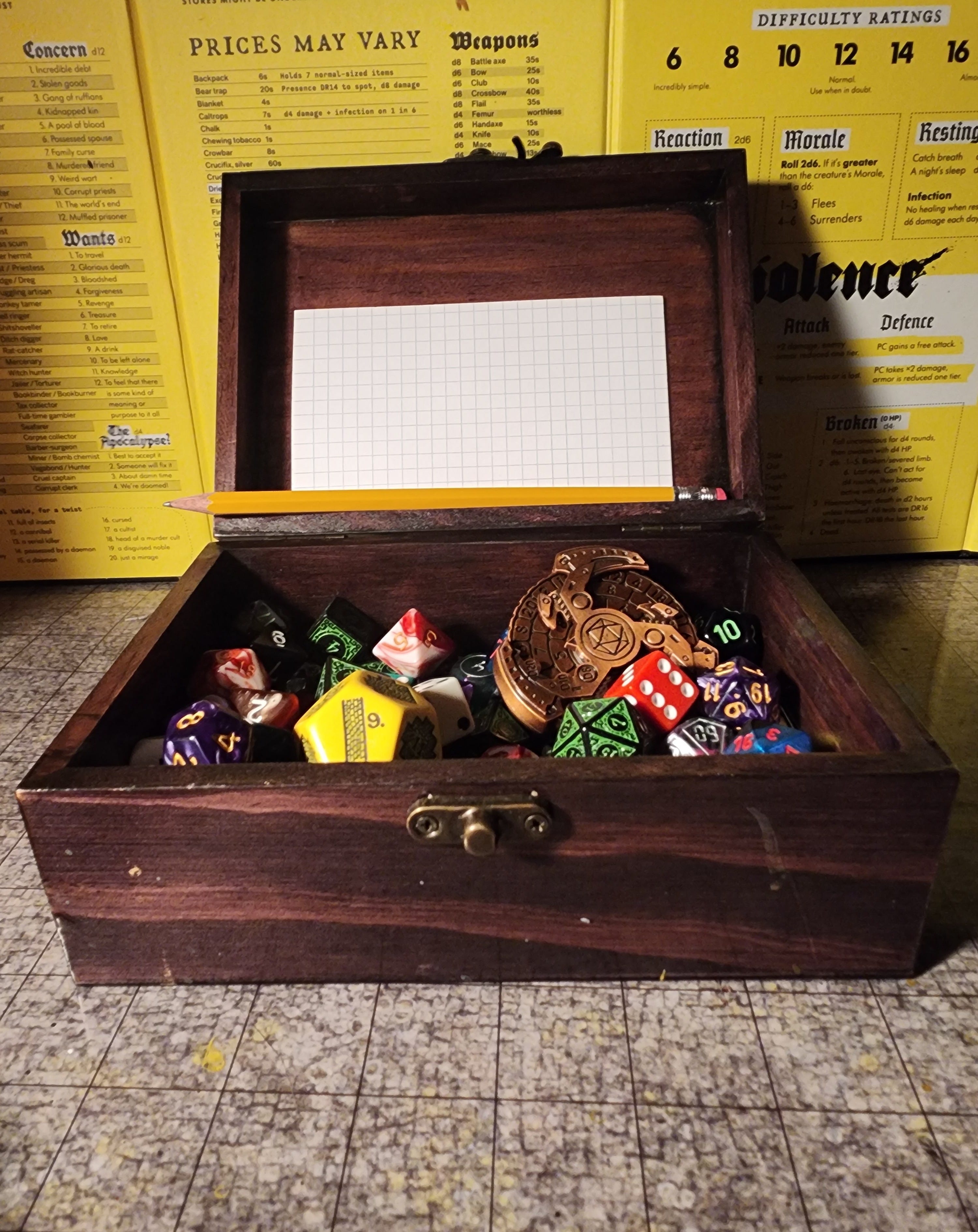
Solo RPGs can feel intimidating. No group to bounce ideas off, no GM, no table to gather around . It’s easy to get bogged down in rules, tables, or overthinking every decision. But solo play doesn’t have to be complicated, rigid, or follow anyone else’s idea of “correct”.
The key is simplicity and honesty: knowing what you enjoy, leaning on tools that spark creativity instead of slowing you down, and trusting yourself to improvise when needed. You don’t need expensive miniatures, massive rule books, or perfect notes. You don’t have to limit yourself to certain methods or systems. What matters is your curiosity, imagination, and willingness to explore your own story.
This guide covers three ways to simplify solo play while keeping it fun, flexible, and fully under your control: working with yourself, reshaping rules, and using oracles effectively.
Work With Yourself, Not Against Yourself
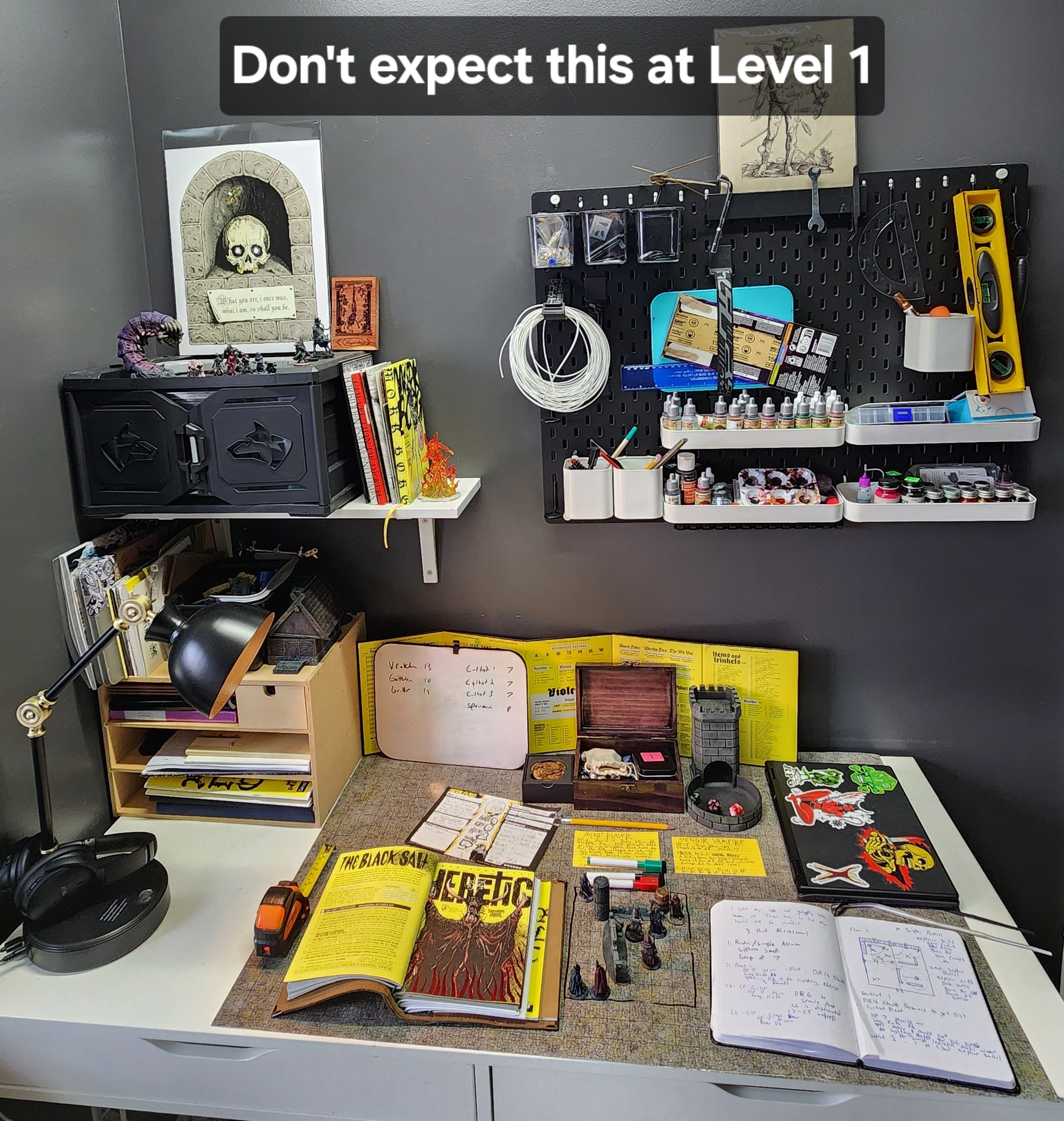
The first way to simplify solo RPGs requires no books, dice, or gear: just honesty. Not a deep-life-choices kind of honesty, but a clear look at how you’re wired. What do you actually enjoy? What are you realistically willing to do to play?
There’s nothing wrong with wishing you had more time, energy, or friends who share the hobby. But if those wishes keep you from enjoying what’s possible, you’re holding yourself back. And if the idea of being a “true gamer” is making you miserable, toss that set of expectations in the trash.
It’s easy to scroll other Substacks with solo reports and think, “My handwriting sucks” or “I can’t draw for shit.” I get it —mine’s awful too. But don’t let that stop you from scribbling notes on a coffee-stained sheet of graph paper or from typing into a Google Doc.
Here are a few ways you can work around some of the time, energy, and financial constraints you may encounter:
No minis? Use coins, board game pieces, or paper standees.
No time for a 200-page rule book? Try a pamphlet game.
No money? Itch.io and DriveThruRPG are full of free solo games that are every bit as satisfying as $50 hardcovers. Some creators even offer free community copies.
Don’t want PDFs but don’t want to spend a lot on books? Libraries, Lulu, and office supply stores make zine printing cheap and easy.
Here’s my character arc:
I was obsessed with tabletop games but starved for people to play with. I devoured my AD&D and 3E rule books — especially The Book of Vile Darkness — and dreamed of grimdark campaigns. I bought board games over the years, hoping I could get enough people interested in playing them only to see them gather dust. I dabbled in Magic: The Gathering and countless D&D groups. I immersed myself in Warhammer 40K lore and could only imagine commanding the Death Korps of Krieg in battle. As much as I would have loved to buy the right minis, paints, and Codexes, they were no match for mortgage and auto payments.
Every path hit the same wall: cost, burnout, or people who didn’t want the same things I did.
Eventually, I stopped fighting it. I accepted that what I really wanted was the experience of building worlds and telling stories, and fighting high-stakes battles. Not chasing the perfect group or spending hundreds (or thousands) on board games, cards and minis with the possibility of enjoying myself in an environment where the priority was winning tournaments. I didn’t want to compete with other gamers. I wanted to compete with myself as a world-builder, explorer, and as a craftsman.
That’s when solo play found me.
Now I 3D print minis on a whim, stage my own skirmishes with Forbidden Psalm and The Last War, and even use Magic cards to stat out Mörk Borg monsters. I get to play RPGs whenever and however I want, and I’ve built something that scratches the same creative itch as Warhammer 40K or Magic — without the cost or frustration.
I could have seen myself as a failure at D&D, Magic, and 40K. Instead, I got honest about my time, money, and attention and found a way to play that fits me better than anything else ever has.
Remember, a good adventurer doesn’t need expensive gear. Just a desire for adventure and a little resourcefulness. The rest you can get as you level up.
Rules and Procedures Are Suggestions
You might find a game mechanic that excites you but feels clunky in practice. Too many steps, redundant rolls, or too much table-hopping. That’s fine. Feeling that way doesn’t mean you misunderstood the game or disrespected the designers.
You don’t have to follow tables verbatim. You can respect the creators while focusing on the spirit rather than the letter of their rules. RPG mechanics are answers to specific design problems, not divine law. Once you understand what problem a rule is trying to solve, you can trim or reshape it to fit your needs.
Think of games as living documents, edited in real time. If D&D had gotten everything “perfect” in the ’70s, we’d still be playing BX. Each new edition reflects what players wanted at the time. Sometimes a later rule just answers a different question or addresses a different need that hadn’t come up yet. Your job, as a solo player, is to decide which questions you actually want your game to ask and which ways you’ll get to answer them.
That’s how I approached the “Weak Hit Consequences” mechanic from Solitary Depths. On paper, it’s a good idea: when you partially succeed, you roll on a table to see what the setback is. In practice, though, it kept making me pause and ask the same thing: “What’s actually happening?”
Here’s the original version:
Weak Hit Consequences (1d6)
Small damage (d2/d4)
Introduce new danger (see “Reveal a Danger”)
Lose an item. Roll d6 to see what you lose. (1–3) or 20 silver (4–6)
Unintended negative effect
Surprising negative development
A friend (or you) is put in harm’s way
It’s functional, but every result is just another flavor of “something bad happens”. Results 4 and 5 are almost identical, #2 points you to another table of bad things that can happen, and several overlap with each other. Instead of clarifying the consequence, it creates more questions. Who is getting affected? How bad is this going to be? What’s the difference between a negative effect and a development? Is a danger also considered a “negative development”?…..
So I rebuilt it into something faster and easier to interpret — a structure that asks three useful questions instead of the same vague one:
1. What’s happening? (d4)
Take or deal reduced damage
Intended primarily for attacking/defending. But if doing something else, you could simply take damage.
Lose something (silver or an item).
Suffer a penalty on your next action.
Trigger an event (enemy encounter or environmental hazard).
2. How bad is it? (d6)
1–2. Inconvenient
3–4. Bad
5–6. Disastrous
This one will require the most discretion but let’s use “Suffer a penalty on your next action” as an example:
Inconvenient: -2 to any checks made on next action.
Bad: -4 to any checks made on next action.
Disastrous: -6 to any checks made on next action.
3. Who is Affected? (d4)
Me
An ally
Me and an ally
Everyone
This revision gets straight to the point. It keeps the fiction moving and gives me just enough scaffolding to improvise a consequence that fits the scene.
Being able to recite rules from memory is nice, but mastery isn’t about memorization. It’s about application and understanding the issues and questions that need to be answered. When you understand why a rule exists, you can reshape it to fit your game without breaking it. The goal isn’t to obey the system — it’s to make the system obey you. Or in more simple terms, mastery.
Using Oracles to Start, Not Solve
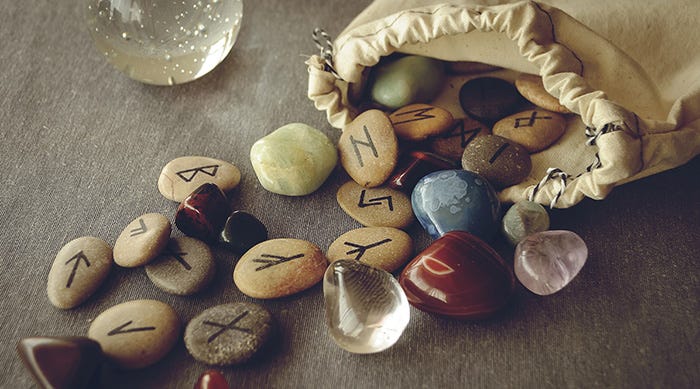
Over-reliance on oracles can lead to analysis paralysis. You might find yourself rolling repeatedly, trying to reconcile contradictory results, and losing sight of the story.
Remember: oracles are there to create context, not to write the entire scenario. Use them to provide the basics—who, what, when, and where. The why and how can often be inferred through context, or even ignored entirely. What matters is keeping the story moving. It’s perfectly fine to exclude or reinterpret results if they don’t fit the narrative you want.
For example, in my Grotten campaign, one party member, Ulm, was a former mercenary who served in the same company as Drugel. When I first rolled his “wants” and “concerns”, the oracle suggested he was looking to save a loved one. That didn’t fit easily into Drugel’s story, and I wanted the Goblin King to be more than another lecherous Goblin kidnapping fair maidens, so I re-rolled Ulm’s “wants” and “concerns”. Ulm’s new goal became “to retire.” Using context clues—like his high opinion of Drugel—I concluded he’d team up with someone he trusts, which shaped his personality: risk-averse, pragmatic, and loyal. Meanwhile, the bigger picture remained intact: the vampire and the demon are connected to a cult attempting to resurrect a powerful entity, which I had rolled as the final boss in Drugel’s story.
Oracles can also work on a smaller, “room-by-room” scale. For example, when exploring a dungeon, I might roll for a room’s adjectives and type. One roll gave me a “ruined/ancient crypt”. That single result informed multiple improvisations:
Enemy encounters: Easy to imagine skeletons as denizens, or a spirit enraged that its rest has been disturbed.
Environmental hazards: The brittle stone and support structures might collapse during combat, causing damage, or the floor could give way beneath the party.
Narrative flavor: The ancient ruin gives the space a haunted, mysterious tone without me having to plan every detail.
By using oracles this way, you have context to guide improvisation: the room suggests possibilities, but you decide the specifics as the story unfolds.
Whether for large narrative threads like Ulm’s story or small environmental details like a crypt, oracles give seeds, not scripts. You can discard, reinterpret, or combine results to keep the story moving, trust the cues that spark ideas, and leave some threads for the next session. That’s how momentum builds in solo play and goes back to the first piece of advice which is “Step one: work with yourself, not against yourself”.
Final Thoughts
Solo RPGs aren’t about following every rule perfectly or forcing yourself to fit a mold. They’re about finding the balance between structure and freedom, between rules that guide and intuition that drives. Work with yourself, not against yourself. Know what energizes you , whether it’s tactical problem-solving, creative world-building, or improvising consequences on the fly, and let that be your compass.
Rules and mechanics are suggestions. Oracles are starting points. Your instincts and your willingness to experiment are the tools that actually make the story happen. By understanding yourself, your preferences, and your limitations, you can transform solo play from a source of stress and confusion into a playground for imagination, strategy, and storytelling.
I love this. I have found myself more and more willing to alter rules that don’t work well for me as I play solo. At first, since I was sharing my Actual Plays, I was afraid of the troll community telling me “I was doing it wrong” or some variation of that. As far as I am concerned, if I’m having fun, then I am doing it perfectly. You hit the nail on the head with this article.
Great article! Another thing I would suggest for beginner solo RPGers which ties into your first point - don't be afraid of admitting something isn't working even if you were sure it would be perfect for you. It's surprising but solo roleplaying really is something that you need to practice at and you'll find it flows easier over time.
Maybe you thought you would love detailed narrative journalling but instead found it made play really drag. That's okay! Try bullet points instead. That's what I did - now I go back and write up my sessions after playing rather than during. But for a while I did feel like I was 'doing something wrong' because I wasn't having as much fun as I expected. Once I identified the cause, I switched things up and now am enjoying myself way more. It's not failure, it's just learning.